Since today is the 20th anniversary of the fall of the Berlin Wall (please see my previous post, “Democracy, East Germany and the Berlin Wall” by Stephen Gowans), lets take a closer look at bourgeois democracy, since it is supposedly so fabulous according to the self-congratulatory imperialist media:
That would all be funny if this farce weren’t backed by force:
“Bourgeois democracy, although a great historical advance in comparison with medievalism, always remains, and under capitalism is bound to remain, restricted, truncated, false and hypocritical, a paradise for the rich and a snare and deception for the exploited, for the poor.” – V. I. Lenin, Bourgeois and Proletarian Democracy
As the hysterical propaganda against socialism goes into full-swing on the 20th anniversary of the fall of the Berlin Wall, November 9th 2009, I am posting this article, “Democracy, East Germany and the Berlin Wall” by Stephen Gowans, from his blog, What’s Left. The article cuts through the anti-communist distortions and presents the facts. For the view of the GDR itself, see their brief brochure, “What you should know about the wall” from 1962. For a more ideological look at the fall of the GDR, please see “Errors and Successes in the Building of Socialism: Strong and Weak Aspects of the Struggle Against Revisionism” by Kurt Gossweiler, in the collection Collapse of the Soviet Union: Causes and Lessons:
East German monument to Karl Marx
The GDR was more democratic, in the original and substantive sense of the word, than eastern Germany was before 1949 and than the former East Germany has become since the Berlin Wall was opened in 1989. It was also more democratic than its neighbor, West Germany. While it played a role in the GDR’s eventual demise, the Berlin Wall was at the time a necessary defensive measure to protect a substantively democratic society from being undermined by a hostile neighbor bent on annexing it.
To mark the 92nd anniversary of the Great October Socialist Revolution on November 7th 2009, I am posting the following article by William Z. Foster from 1939, “Lenin and Stalin as Mass Leaders“:
The legacy of October lives on!
The great revolution of October, 1917, which abolished Russian capitalism and landlordism and set up the Soviet government, resulted in the establishment of socialism throughout one-sixth of the earth, and is now surging forward to the building of communism, constitutes the deepest-going, farthest-reaching, and most fundamental mass movement in all human history. The two chief figures in the Communist Party heading this epic struggle—Lenin and Stalin—have continuously displayed, in its course, unequalled qualities as political leaders of the working class and of the toiling people generally.
The following is a description of the exciting new book Revolutionary Social Change in Colombia: The Origin and Direction of the FARC-EP by James J. Brittain to be released in February, 2010 by Pluto Press. Professor Brittain will be available to speak about the book:
Compared to other Latin American countries, minor socio-political analysis has been given to contemporary Colombia. This lack of investigation is perplexing due to Colombia’s geographical and socioeconomic importance worldwide. The Andean country has one of the largest reserves of fossil fuels in the world, it is home to the longest running civil war in the hemisphere, it has the second highest number of internally displaced persons on the planet, it remains one of the most inequitable countries in the region, and is the poster-child of the international drug trade. Amidst such conditions, Colombia also holds a unique and interesting history of resistance against dominant political-economic interests.
At the helm of this decades-long struggle has been the Revolutionary Armed Forces of Colombia-People’s Army (Fuerzas Armadas Revolucionarias Colombianas-Ejército del Pueblo, FARC-EP). Regarded by some as the largest and most powerful political-military force in Latin American history, modest research has been conducted on the FARC-EP and lesser still accessible to the public. With what little is propagated, much depicts the insurgency as nothing more than an outdated ideologically-lacking guerrilla movement violently enmeshed in Colombia’s narcotic industry.
Attempting to fill a much-needed void, Revolutionary Social Change in Colombia evaluates the unique theoretical and pragmatic composition of the insurgency and its relation to radical social change within Colombia. As the FARC-EP continues to be a symbolic power both regionally and globally, it is important to analyze where and why this organization came into existence and whether the insurgency has the potential to create conditions for an emancipatory transformation of Colombia. After spending the greater part of ten years analyzing the FARC-EP in both text and person, James J. Brittain addresses the question of who the FARC-EP are, what they are doing in Colombia, and if this insurgency can assist in the creation of a social and political revolution of, by, and for those marginalized in Colombia.
The following is from the website of the Popular Front for the Liberation of Palestine (PFLP), a Marxist-Leninist organization in Palestine fighting for national liberation and socialism:
The Popular Front for the Liberation of Palestine said on November 3, 2009 that the Palestinian Authority, and all Palestinian parties, must immediately end any and all illusions about the United States or its president, Barack Obama, and instead reject its “negotiations” based on surrender and rely on the Palestinian people and their resistance, unity and national rights.
Here is an important document from the encylopedia of anti-revisionism by Harry Haywood, the great communist theoretician of the African American national question:
Class Struggle, theoretical journal of the October League (Marxist-Leninist), No.1, Spring 1975
October League (M-L) Introduction: Harry Haywood is a veteran Black Marxist-Leninist, now living in Detroit. He has spent several decades as a leading member of the Communist Party USA and as a fighter against modern revisionism.
In 1928 and 1930, Haywood helped draft the Resolutions of the Communist International as well as the position of the CP on the Afro-American national question. His thoughts on this question were summed up in his famous book, “Negro Liberation.”
Haywood broke from the CPUSA in the late 50’s after the party had thoroughly abandoned the revolutionary struggle for socialism and Black liberation. Along with other anti-revisionists, he helped form the Provisional Organizing Committee (POC). The POC, like many of the new communist organizations of today set as its main task, the building of a new Marxist-Leninist party.
The POC failed in this first attempt at a new, anti-revisionist party. Haywood’s letter upon leaving the POC shows some of the reasons why it failed and serves as a lesson to those who might try to follow in the ultra-“left” footsteps of these sectarians.
Nepal: The Tactic of General Insurrection
by Gary Leupp / November 2nd, 2009
[N]ow we are focusing on the mass movement… [N]ow we [can] really practice what we have been preaching. That means the fusion of the strategy of PPW [Protracted People’s War] and the tactic of general insurrection. What we have been doing since 2005 is the path of preparation for general insurrection through our work in the urban areas and our participation in the coalition government.
– Maoist leader Baburam Bhattarai, interview with the Britain-based World People’s Resistance Movement, October 26, 2009
Today (November 1) Nepal’s Maoists initiate, with torch rallies in Kathmandu, a mass movement to bring down the regime. This is the regime that succeeded the one their chair Prachanda headed as prime minister from August 2008 to May 2009–a compromise arrangement, always understood to be temporary and transitional, that collapsed when the Nepali Army refused to take orders from the Maoist prime minister.
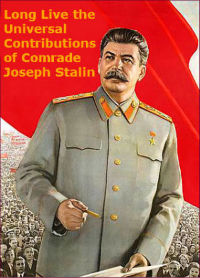
The following presentation was made by Harpal Brar, Chairman of the Communist Party of Great Britain (Marxist-Leninist), to the Stalin Society on 18 October 2009 to mark the 60th anniversary of the founding of the People’s Republic of China and the forthcoming 130th anniversary of the birth of Stalin. It is taken from Chapter 13 of his book, Trotskyism or Leninism? It was again published and is being reprinted here from the November/December 2009 issue of the British anti-imperialist and Marxist-Leninist journal, Lalkar:
Stalin and the Chinese Revolution: Two lines on the Chinese Revolution - the line of the Comintern and Stalin versus the line of the Trotskyist opposition
In the latter half of the 1920s the Trotskyist opposition (Trotsky, Zinoviev, Radek and Kamenev) accused the ‘Stalinist bureaucracy’ i.e. the Communist Party of the Soviet Union (Bolshevik) [CPSU(B)] and the Comintern of selling the Chinese Revolution and the Chinese communists down the river – of betraying the Chinese Revolution.
This slander has since then been picked up, and repeated thousands of times, by the Trotskyite counter-revolutionaries, revisionist renegades, social democrats, and even by some dubious Marxist-Leninists. Every attempt is made by this gentry to invent sharp difference of opinion between Stalin and Mao Zedong, between the line of the Comintern, which was the same as that of Stalin and the CPSU(B), on the one hand, and that of Mao Zedong, on the other hand, on the question of the Chinese Revolution. Nothing could be further from the truth.
On November 3rd, 1979, the Workers Viewpoint Organization (which would become the Communist Workers Party) held a anti-Klan rally in Greensboro, North Carolina. Five WVO cadres were killed by the Ku Klux Klan with the assistance of the Greensboro Police. The following is an excellent documentary about the Greensboro Massacre, called “Greensboro’s Child“.
The Beloved Community Center, Greensboro Justice Fund, and other organizations in Greensboro are hosting a conference and other events to commemorate the “30th Anniversary of the Tragic Killing of Five Labor and Community Organizers by Klan and Nazis in 1979″ from Nov. 4-7th.
Armando Robles, president of UE Local 1110 and one of the leaders of the Republic Windows and Doors occupation, addresses the crowd outside the bankers' convention Oct. 27. (Fight Back! News/Jonathan Labe)
Chicago, IL - The American Bankers Association met here the week of Oct. 26, in luxury hotels, spending millions for their comfort. Outside, 2500 working people marched and chanted, “You got bailed out, we got sold out!”
Rosemary Williams, who fought eviction from her home in Minneapolis, Minnesota, was in the march and said, “We need a moratorium on foreclosures.” She spoke at a breakfast for Jobs With Justice to kick off the day of protest. Her message to anyone facing foreclosure is to fight. “If the bank comes for your home, don’t go quietly in the night. Get people together and fight back.”
Claudia Jones was born in Trinidad in1915 but migrated to Harlem in 1924. She became active in the Scottsboro struggle. She became a leader of the Comunist Party in the 1940’s, until she was indicted under the Smith Act (under which teaching Marxism was illegal) and imprisoned in 1955. She was then deported to London, where she lived and worked until her death 1965. She was buried beside of Karl Marx.
To get an idea of her importance, read her article, “An End to the Neglect of the Problems of the Negro Women” (PDF), which analyzed the situation of black women from a Marxist viewpoint, and which was her major contribution to feminist thought.